Forget Another
Anti‑Aging Cream:
Try Red Light After 50
Why creams do so little for lines after 50, what red and near-infrared light can reach instead, and how to choose a mask that's worth it.

The Veltmore Journal · Advertorial
5 Nov 2026 · 6 min read · 8 sources

For fifteen years in a skin clinic, the line I heard most was “I look tired, but I don't feel tired.” Usually from women with a drawer full of serums. If that sounds familiar, you're not alone. The problem is rarely the cream. It's what happens underneath the skin.
Why fine lines stop fading after 50

Maybe you've noticed it too:
- You look more tired than you feel.
- Fine lines around your eyes and mouth don't fade anymore.
- Years of Australian sun are starting to show.
- Your jawline and neck feel less firm.
Firmness comes from collagen, a network of fibres in the dermis, the second layer of your skin. We make a little less every year, and after menopause it drops sharply: one often-cited study found women can lose around 30% of their skin collagen in the first five years.[7]
Why creams struggle, and what light can reach
Your skin's outer layer is built to keep things out, so most creams stay near the surface. Lovely for hydration, but they struggle to reach the dermis. Light doesn't need to soak in: red light (around 630 nm) works in the upper layers and invisible near-infrared (around 850 nm) travels deeper, towards where collagen is made.[3]
- 1The light passes the surface
Red and near-infrared go through the outer layer that creams struggle to get past.
- 2
- 3
Read the science
Inside each cell's mitochondria sits an enzyme, cytochrome c oxidase, that absorbs light at red and near-infrared wavelengths.[1] In older and stressed cells, nitric oxide sits on that enzyme and blocks oxygen. The light knocks it loose, oxygen binds again and the cell makes more ATP, the fuel it runs on.[2]
Collagen-making cells (fibroblasts) put that extra energy into repair work, including new collagen. That's the process the clinical trials further down measured.
Not all LED masks are equal
Red and near-infrared light can help the appearance of ageing skin. But LED masks differ a lot in their wavelengths, their fit and what happens if they don't suit you, and the studies were done with specific settings. So before price or looks, these are the things worth checking.
Near-infrared is the part that travels deeper, towards the collagen layer. A mask that only says “red light” may not include it.
Veltmore630 nm red + 850 nm near-infrared, combined in one mode.
The research used specific wavelengths. If a listing gives no numbers, you can't compare it with the studies.
VeltmoreWavelengths stated on the product page, as supplied by the manufacturer.
Results come from regular use over months. A hard shell that presses on your nose is easy to leave in the drawer.
VeltmoreSoft, flexible silicone with an adjustable strap, so it settles onto your face while you lean back.
The simpler a session is, the more likely it becomes a habit.
VeltmoreHandheld controller with a display and a built-in ten-minute timer. Wired, so there's no battery to run flat.
Skin and comfort are personal. You should be able to try it at home without being stuck with it.
Veltmore30-day money-back guarantee, even after use. Questions go to a real inbox: contact@veltmore.com.
Why fit matters so much: the mask bends in your hands, and on your face it follows your contours instead of pressing on the bridge of your nose. That's what makes ten minutes on the couch feel like a break rather than a chore.
Specifications as supplied by the manufacturer. The Veltmore mask itself has not been tested in a published clinical trial.
Why I created Veltmore

I worked in a skin clinic for fifteen years. Again and again I saw women come in for LED, love how their skin felt, and then stop after a few sessions, because a course of clinic visits adds up fast.
So at 58 I set out to make a mask with the same type of light for at home: soft enough to wear on the couch, and simple enough to use every week. It took years of research and testing to get it right.
A lot of cheaper masks only have red light. We wanted something that reaches the deeper layer. I know you've done your research. We did ours too.

Red + near-infrared, made to be worn
- 630 nm red + 850 nm near-infrared
- Soft silicone, adjustable strap
- 10 minutes, built-in timer
A$219.99 A$329.99 Save A$110
Black Friday price until Monday 9 November · Free shipping AU & NZ · 30-day money-back guarantee
See sets and prices4.9 from 72 reviews on the Veltmore product page
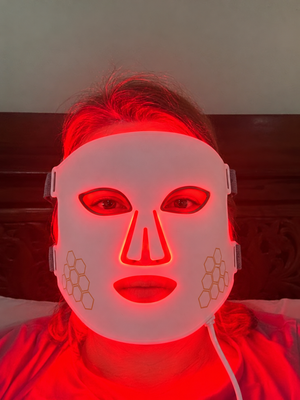
“...the first thing she said was 'your skin looks amazing!'”
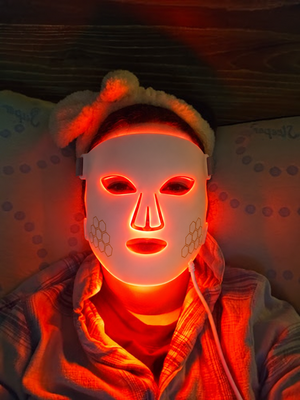
“The mask is really comfortable to wear. I have dozed off a few times wearing it.”
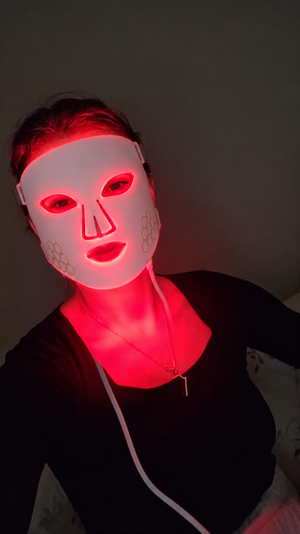
“I use it every day and my 66 year young is glowing.”
How it compares with the usual options
The real alternatives for most women: more creams, or LED sessions at a clinic.
- Veltmore
- Light travels into the skin, near-infrared towards the dermis
- Clinic LED
- Same type of light, in a clinic
- Creams
- Mostly near the surface
- Veltmore
- One-off, from A$219.99
- Clinic LED
- Paid per session, usually as a course
- Creams
- Repeat purchases
- Veltmore
- 10 minutes at home, whenever suits you
- Clinic LED
- Appointments and travel
- Creams
- Easy, daily
- Veltmore
- 30-day money-back, even after use
- Clinic LED
- Depends on the clinic
- Creams
- Depends on the shop
LED doesn't replace sunscreen or your skincare. Keep your daily SPF and use LED alongside them.
What customers say
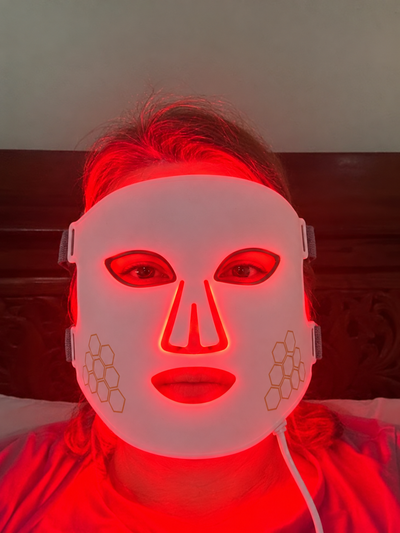
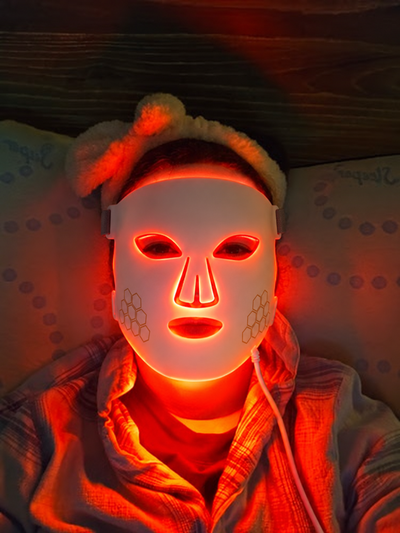
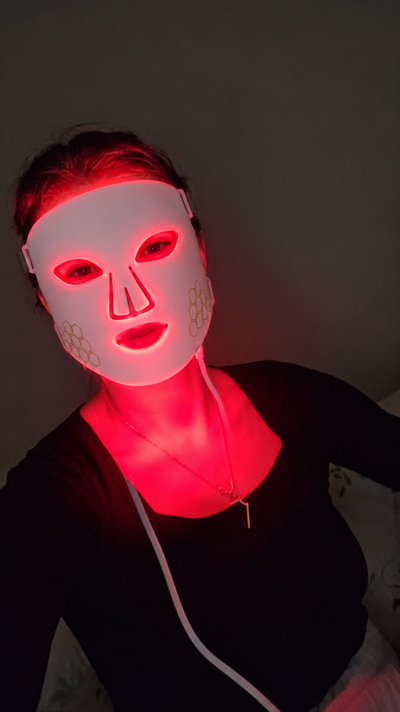
Reviews and customer photos as shown on the Veltmore product page. Individual experiences vary.
What the research found
Red and near-infrared light has been tested in controlled clinical trials. These two are the most relevant for fine lines.
76 adults. 633 nm red and 830 nm near-infrared LED versus a sham light. Wrinkles were measurably reduced and skin samples showed more collagen.
J Photochem Photobiol B, 2007 [5]136 adults. Red and near-infrared light versus an untreated control group. Fine lines, roughness and collagen density improved.
Photomed Laser Surg, 2014 [6]What this does and doesn't show. Both studies used clinical LED devices under trial conditions, with wavelengths close to Veltmore's (633/830 nm). They support red and near-infrared light in general; they did not test the Veltmore mask, and results with home masks are usually more gradual.
Three light modes, three jobs
Red + near-infrared is the one to use most after 50. Blue and purple are extras, selected on the same controller.
The one to use most after 50. Near-infrared reaches the collagen layer.[5][6]
Stays near the surface, for clearer-looking skin. The evidence is mixed, so see it as a bonus.[9]
Blue for the odd spot and red for fine lines, in one session.
There is also a red-only setting. Follow the instructions that come with your mask for settings and session length.
What comes with every mask

- LED face mask, White or Black
- Handheld controller with digital display
- Adjustable strap
- USB cable
- Gift box
What to expect if you start
- CleanseClean, dry skin.
- Put it onAdjust the strap.
- Choose a modeOn the controller.
- Relax10 minutes, 3 times a week.
Ten minutes, a few times a week.
Smoother texture and softer lines come slowly.
Collagen keeps declining, so keep it in your routine.
Questions before you order
How long is a session, and how often?
About ten minutes, three times a week, on clean, dry skin. The timer switches the mask off for you. Regular use matters more than long sessions.
When might I notice a difference?
Think months rather than days. In the trials, changes were measured after weeks of regular sessions, and they differ from person to person. We can't promise a specific result.[5][6]
Is it comfortable?
It's soft, flexible silicone that follows your face, with an adjustable strap, so you can lean back on the couch. You can wear it while reading or watching TV.
Is it easy to use?
Put it on, choose a mode on the controller, press start. The built-in timer ends the session. It's wired, so there's nothing to charge.
Is it safe?
Keep your eyes closed during a session. If you have an eye or skin condition, are pregnant, are sensitive to light or take medication that makes you photosensitive, check with your GP first. For ongoing or severe acne, see your GP.[4][9]
Can I keep using retinol and my serums?
Yes. Use the mask on clean skin, then apply your skincare. If a retinoid has irritated your skin, give it a rest first.
What if I don't like it?
The 30-day money-back guarantee covers the LED face mask, the neck & décolleté mask and the LED kits, even if you've used them. Email contact@veltmore.com within 30 days of delivery with your order number and we'll send return instructions. Send it back clean with its accessories within 14 days of those instructions. You pay the return postage; we refund what you paid within 10 business days of receiving it. Free collagen masks from a kit don't need to come back.
Choose your set

- In the box
- LED face mask, neck & décolleté LED mask and LED spot wand with their accessories, plus 10 collagen sheet masks (free), in a gift box.
- Delivery
- Dispatched within 1–3 business days, with you in about 6–13 business days (AU & NZ). Tracking by email.
- Shipping
- Free to Australia and New Zealand, no minimum.
- Try it at home
- 30-day money-back guarantee on the masks and kits, even if you've used them. Send them back clean with their accessories; you pay the return postage and we refund what you paid within 10 business days of receiving them. The free collagen masks don't need to come back.
- Payment
- Secure checkout with Apple Pay, Google Pay or card.
- Karu TI. Multiple roles of cytochrome c oxidase in mammalian cells under action of red and IR-A radiation. IUBMB Life. 2010;62(8):607–610. PubMed
- Hamblin MR. Mechanisms and applications of the anti-inflammatory effects of photobiomodulation. AIMS Biophysics. 2017;4(3):337–361. PubMed
- Avci P, Gupta A, Sadasivam M, et al. Low-level laser (light) therapy (LLLT) in skin: stimulating, healing, restoring. Semin Cutan Med Surg. 2013;32(1):41–52. PubMed
- Cleveland Clinic. Red light therapy: benefits, side effects and uses (patient information). clevelandclinic.org
- Lee SY, Park KH, Choi JW, et al. A prospective, randomized, placebo-controlled, double-blinded, and split-face clinical study on LED phototherapy for skin rejuvenation. J Photochem Photobiol B. 2007;88(1):51–67. PubMed
- Wunsch A, Matuschka K. A controlled trial to determine the efficacy of red and near-infrared light treatment in patient satisfaction, reduction of fine lines, wrinkles, skin roughness, and intradermal collagen density increase. Photomed Laser Surg. 2014;32(2):93–100. PubMed
- Brincat M, Moniz CJ, Studd JW, et al. Long-term effects of the menopause and sex hormones on skin thickness. Br J Obstet Gynaecol. 1985;92(3):256–259. PubMed
- Scott AM, Stehlik P, Clark J, et al. Blue-light therapy for acne vulgaris: a systematic review and meta-analysis. Ann Fam Med. 2019;17(6):545–553. PubMed
